


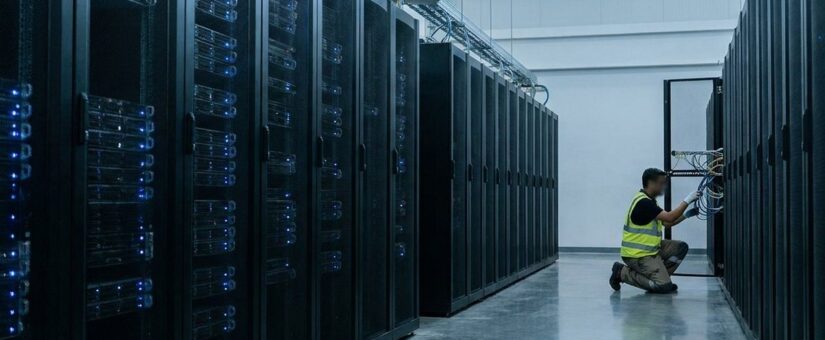
Mexico Takes Its Place in the AI Boom: New Opportunities for Investment and International Talent
- Posted by javiadas
- On Thursday August 20th, 2026
- 0 Comments
For thirty years, cars defined Mexico’s role in North American manufacturing. In 2026, that is changing. The servers and computer equipment that power artificial intelligence have become the country’s leading export.
According to an S&P report cited by El País, Mexico’s exports of computer equipment grew 172% in the first half of 2026 and reached US$82.9 billion. Cars and auto parts, the traditional leader, totaled US$74.8 billion over the same six months. About 93.9% of the computer equipment went to the United States, where AI data centers are expanding fast.
For companies, this shift opens new space for investment. For HR and mobility teams, it raises a practical question: who will build, run and scale these operations?
How Mexico became a server hub
The story starts in Taiwan. Taiwanese firms make the advanced chips used by companies such as Apple, Nvidia and AMD. More and more of them assemble those chips into servers in Mexico and ship them north. Under the USMCA, those servers can enter the United States without tariffs.
A Banamex study reported by Mexico News Daily on August 14 found that Mexico supplied 34.5% of U.S. server imports in the first half of 2026, close to Taiwan’s 36%. In the second quarter alone, Mexico’s share approached 40%. Mexico’s AI server exports to the United States passed US$60.4 billion in those six months.
The names behind the numbers are familiar to anyone in electronics. Foxconn runs an AI server plant in Guadalajara. Inventec plans to invest US$450 million in Ciudad Juárez. Wistron and Flex also operate in the country. El País lists Ciudad Juárez, Tijuana, Mexicali, Reynosa, Zapopan and Apodaca as the main assembly hubs, across the north and the Bajío.
Data centers move to the Bajío
The second part of the boom is data centers. Querétaro has become the country’s main hub. On August 14, KIO Data Centers announced more than US$1.3 billion for its third complex in the state, a facility of about 100 MW in the El Marqués industrial park. Economy Minister Marcelo Ebrard said Querétaro will host 80% of Mexico’s data center operations once the project is done, according to Publimetro.
State officials told The Logistics World that data center investment in Querétaro has passed US$10 billion over the last two years. The state’s plan aims to serve AI companies by 2030 and lists names such as OpenAI, Meta, Anthropic and Mistral AI as potential clients.
The limits: value, power and people
The boom comes with three limits that matter for any company planning to invest.
Value. Banamex notes that Mexico mostly handles final assembly. Chip design, technology integration and supply chain coordination stay in Asia. In its words (our translation), the server industry shows “lower levels of national content” and less local value than the auto sector. El País adds that the jump in exports does not yet show up clearly in employment data.
Power. Data centers need large amounts of reliable electricity. “The grid Mexico has right now barely covers current demand,” wrote Valeria Moy, director of the Mexican Institute for Competitiveness (IMCO), as quoted by El País (our translation). “Without more energy capacity, there will be no way to capture this window of opportunity.”
People. Analysts quoted by El País say data centers will need a more skilled workforce than traditional assembly. ManpowerGroup’s 2026 Talent Shortage Survey, reported by Publimetro in March, found that 67% of employers in Mexico struggle to fill roles. For the first time, AI skills ranked as the hardest to find, ahead of engineering and traditional IT.
Trade policy adds a fourth question. In July, the United States declined to extend the USMCA in its current form at its first joint review. The agreement remains in force until 2036 and its benefits still apply, Greenberg Traurig explains, but it will now go through yearly reviews. For a business model built on tariff-free access to the U.S. market, that is a factor worth watching.
Where international talent comes in
A server plant or a hyperscale data center does not start with local hires alone. The first teams often include people from the parent company or from sister plants in Taiwan, the United States or Europe. Typical profiles include:
- Plant and operations directors who set up new production lines for AI servers.
- Process, test and quality engineers who know the client’s standards for high-performance hardware.
- Data center specialists in electrical systems, cooling and critical facilities.
- Network, cloud and cybersecurity experts for commissioning and early operation.
- Supply chain managers who coordinate parts arriving from Asia and products leaving for the United States.
Many of these assignments are short or medium term. The goal is to launch the operation, train local teams and hand over. Others become long-term roles as companies build regional hubs. Either way, the people involved often move with families, and they need to be productive in weeks, not months.
What mobility teams should plan
The new AI corridors are not the classic expatriate destinations. Ciudad Juárez, Reynosa, Mexicali and El Marqués each have their own housing market, school options and daily logistics. A few points deserve early attention:
Immigration. The Mexican entity needs an active employer registration with the National Migration Institute before it can request work visas. New subsidiaries and joint ventures often have to start this step from zero. Short-term technical visits and longer assignments follow different rules, so the type of stay must be clear from the start.
Housing. In fast-growing industrial cities, good rental stock near the plant goes quickly. Commute times, security and access to international schools shape the right choice of neighborhood.
Schools. Families arriving from Taiwan, Korea, the United States or Europe often look for bilingual or international programs. Places in these schools are limited and fill early.
Settling in. Bank accounts, tax ID, health coverage, driver’s licenses and cultural orientation all take time. For engineers on a launch schedule, solid support here is part of hitting the start date.
Looking ahead
Mexico now sits at the center of the AI hardware supply chain for North America. Whether it captures more value, more jobs and more skilled work depends on energy, trade policy and talent. The companies already moving into the server and data center corridors are betting that Mexico will solve those questions. Getting the right people in place, with their families settled, is part of that bet. SRS helps HR and mobility teams with immigration, home search, school search and settling-in services across Mexico’s new technology hubs.
Sources
- México toma la delantera en el auge de la IA con las exportaciones de equipo de cómputo. El País México, 2026-08-15
- Mexico moves past Taiwan as the top AI server exporter to the United States. Mexico News Daily, 2026-08-14
- Querétaro albergará 8 de 10 data centers en México. Publimetro Querétaro, 2026-08-14
- Querétaro redibuja su mapa industrial entre la IA, la electromovilidad y el espacio. The Logistics World, 2026-08-18
- Histórico: la IA desplaza a la ingeniería como talento más escaso. Publimetro México, 2026-03-02
- USMCA Joint Review Triggers Annual Reviews but Does Not Alter Current Trade Benefits. Greenberg Traurig, 2026-07-13


0 Comments