


Mexico Sets a New Foreign Direct Investment Record: Which Sectors Are Attracting Capital and International Talent?
- Posted by javiadas
- On Sunday September 20th, 2026
- 0 Comments
Mexico has a new investment record. Between January and June 2026, the country received US$34.97 billion in foreign direct investment (FDI), according to the Ministry of Economy. That is 2.1% more than the figure first reported for the same period of 2025, and the highest first-half total since records began.
The headline is good news. The details are more useful. They show who is investing, in which industries and in which states, and that tells HR and mobility teams where the next wave of international assignments is likely to land.
A record built by companies already in Mexico
The Ministry of Economy breaks FDI into three parts. Reinvested earnings, the profits that foreign companies keep in Mexico instead of sending home, reached US$30.96 billion, or 88.5% of the total. New investment, which covers new companies and fresh capital, was US$2.73 billion (7.8%). Loans between related companies added US$1.29 billion (3.7%).
In other words, most of the record comes from firms that already have plants, offices and payrolls in Mexico and chose to keep growing there. Mexico News Daily reported that new investment fell 13.4% from the first half of 2025.
Other measures point the same way. BBVA Research, using Banco de México’s balance of payments data, reported net FDI of US$24.8 billion for the first half, down 11.7% from a year earlier. Deloitte’s investment monitor, published September 14, counted US$36.3 billion in newly announced investments in the first half, 20.7% less than in 2025. It also found that only 11.3% of the investments committed since 2023 are already in operation.
Deloitte links this caution to the annual review mechanism of the USMCA, higher U.S. tariffs and a harder geopolitical setting. In July, the United States declined to extend the trade agreement in its current form at the first joint review. As Greenberg Traurig explains, the treaty stays in force until 2036 and its benefits still apply, but it will now face a review every year.
For companies, the reading is clear. Investors who already know Mexico are doubling down. Newcomers are waiting for more certainty.
The sectors pulling in capital
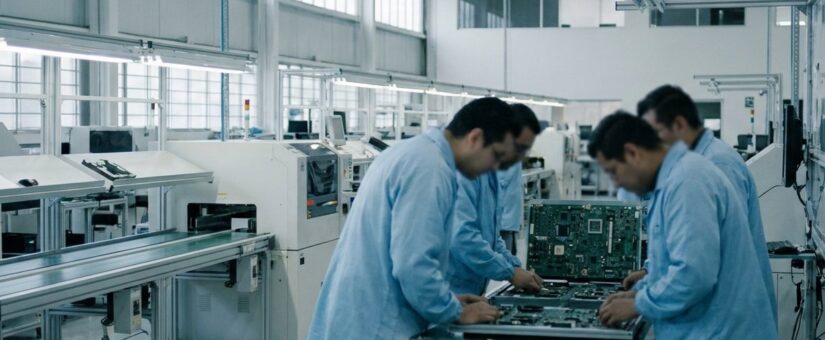
Manufacturing received US$13.48 billion, or 38.6% of all FDI, up 9.3% from the previous year. The biggest increase came from computers, communication equipment and electronic components, which added US$1.17 billion. Basic metals and machinery added another US$464 million.
Financial services and insurance came second with US$10.15 billion (29.0%), up 10.9%.
Transportation, postal services and warehousing was the fastest grower. It reached US$2.65 billion, almost four times its level a year earlier.
Deloitte names three sectors that keep concentrating new project announcements: energy, food and beverages, and transportation, with opportunities centered in the Bajío and the north.
Each of these industries needs a particular kind of expert. Electronics and machinery plants need process engineers, quality managers and maintenance leads. Banks and insurers bring in risk, compliance and technology specialists. Logistics operators need people who can design and run distribution networks. Energy projects need engineers and project managers with experience in regulated markets. These are the profiles companies often move from headquarters or from another country, at least while they train local teams.
Where the money goes
Mexico City captured US$16.86 billion, or 48.2% of the total. Nuevo León followed with US$3.71 billion, then the State of Mexico (US$2.11 billion), Baja California (US$1.74 billion) and Jalisco (US$1.41 billion).
The map of new investment looks different. According to Mexico News Daily, Baja California Sur led with US$524 million, almost all of it in hotels. Nuevo León received US$473 million, up 190.1%, in auto parts, truck distribution, vehicle manufacturing, and iron and steel. Querétaro received US$410 million, up 158.6%, in power generation, food, auto parts and electronic components.
By country, the United States supplied US$16.87 billion (48.2%), followed by Spain (US$4.95 billion), Canada (US$1.74 billion), Australia (US$1.70 billion) and Germany (US$1.65 billion).
What this means for talent
When existing companies reinvest, they expand. They add production lines, open a second plant, move a regional function to Monterrey or Querétaro, or upgrade technology. Each step creates demand for a few people who know the company’s systems from the inside. These are often intra-company transfers: a German engineer who sets up a new line, a Spanish finance director who takes over a growing subsidiary, a U.S. operations manager who supports a plant ramp-up.
Local hiring is also strong. ManpowerGroup’s employment outlook for the last quarter of 2026, reported by Expansión on September 8, showed a national net employment outlook of 41%. Finance and insurance stood at 47%, commerce and logistics at 44%, and technology and IT services at 40%. The Northeast led all regions at 49%. In a hiring market this active, companies often bring in international staff for the roles that are hardest to fill quickly.
Planning the move
Reinvestment moves can look simple because the company is already in Mexico. In practice, they still need careful planning.
Immigration. The Mexican entity must have its employer registration with the National Migration Institute up to date before it requests visas for foreign staff. Assignees who change roles or employers inside Mexico may also need to update their immigration status.
Housing. Expansion corridors in Nuevo León, Querétaro and the State of Mexico have grown fast. Rental supply near new industrial zones can be limited, and the right neighborhood depends on commute, security and schooling.
Schools. International and bilingual schools fill early in Monterrey, Querétaro and Mexico City. Families should apply as soon as the assignment is confirmed.
Settling in. Banking, tax registration, health insurance and local orientation decide how fast a new arrival can focus on work. For short ramp-up assignments, every lost week matters.
The bottom line
The 2026 record says less about new arrivals and more about commitment. Companies that already operate in Mexico are putting their profits back into the country, especially in electronics, finance and logistics, and especially in Nuevo León and Querétaro. That is where many of the next international assignments will come from. SRS supports HR and mobility teams with immigration, home search, school search and settling-in services so that the people behind these expansions arrive ready to work.
Sources
- México registra un máximo histórico de Inversión Extranjera Directa (IED) para un primer semestre: 34 mil 968 millones de dólares en 2026. Secretaría de Economía (gob.mx), 2026-08-24
- Despite a Q2 dip, first-semester foreign direct investment was Mexico’s highest ever. Mexico News Daily, 2026-08-25
- Baja California Sur, Nuevo León and Querétaro lead new foreign investment in first half of 2026. Mexico News Daily, 2026-09-04
- Mexico: Net foreign direct investment shows an annual decline in 1H26. BBVA Research, 2026-08-26
- Monitor de Inversiones: México. Energía, alimentos y bebidas, y transportes: principales motores de inversión. Deloitte, 2026-09-14
- USMCA Joint Review Triggers Annual Reviews but Does Not Alter Current Trade Benefits. Greenberg Traurig, 2026-07-13
- ¿Planeas cambiar de trabajo este año? Estos son los sectores que contratarán más en lo que queda de 2026. Expansión, 2026-09-08

0 Comments